Archive for the ‘Web design’ category

TrackPerformer update

2011-12-17 – 12:05pm

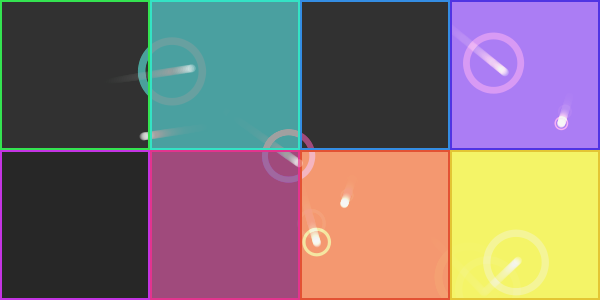
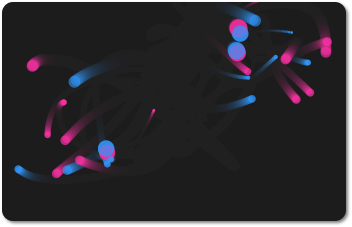
I’ve added in some really exciting new features to my TrackPerformer project, as well as three new performances: We Three Kings, Carol of the Bells, and Joy to the World.

Filters

It’s now possible to add filters, or effects, into the processing chain. These filters can be applied before any performers (pre-filters) or after all performers (post-filters). At the moment, the included filters are:

  • FPS: Calculates the average framerate across the performance, optionally displaying it in a DOM element.
  • Grid: Draws a grid to the canvas. The grid may be a simple intersection grid (points), or lines. Both the X and Y axes may be independently configured.
  • Pick: Probably the most interesting (and processor-intensive) part of TrackPerformer. The Pick filter will randomly swap a pixel with one of its neighbours. It’s used at full intensity on both We three Kings and Joy to the World, and, when toned down a little for Carol of the Bells, provides a softening, organic effect.

I’ve got some ideas for more filters down the track… The only difficulty is keeping performance acceptable: manipulation of the canvas pixel by pixel is quite slow in current browsers.

Performers

There are a couple of new performers, and some minor updates to some of the existing ones. The Oscillator performer, in particular, is rapidly becoming the most flexible and useful of the performers.

  • There’s a new ShimmerGrid performer, which is great for adding texture and movement to the entire canvas. You can see it in action particularly well on Joy to the World.
  • The Swarm performer can now draw its particles as knots (like the SignalTracker), as well as as dots.
  • The Oscillator now has the ability to draw sustained notes, and to increase the longevity of notes. Take a look at Carol of the Bells to see these new options in use.
  • Notes can now be filtered based not only on their pitch, but also their velocity (volume).

There are a couple of other changes here and there, but these are the main ones.

We Three Kings

The three new example tracks are all taken from We Three Kings, my new Christmas remix album. Why not go and have a listen?
CSSMin updated

2011-01-13 – 9:56am

I’ve updated my CSSMin project with a couple of new features and bugfixes. Download or fork it on GitHub!

What is it?

CSSMin takes your CSS file and strips out everything that’s not needed — spaces, extra semicolons, redundant units, and so on. That’s great, but there are loads of programs that do that. A shell script could do that! So what makes CSSMin different?

When you deliver content over the web, best practice is to deliver it gzipped. CSSMin takes your CSS file, and optimises it for gzip compression. This means that there’s a smaller payload delivered over the wire, which results in a faster experience for your users. It does this optimisation by ensuring that the properties inside your selectors are ordered consistently (alphabetically) and in lower case. That way, the gzip algorithm can work at its best.

What this means in practice is that your gzipped CSSMin-ed files are significantly smaller than plain gzipped CSS, and noticeably smaller than files that have been compressed by other means (say, YUI).

In this update:

Nested properties are now fully supported.

This means that the following CSS:

@-webkit-keyframes 'fadeUp' {
  from { opacity: 0; }
  to { opacity: 1; }
}

is compressed down to

@-webkit-keyframes 'fadeUp'{from{opacity:0}to{opacity:1}}

Your nested properties will have their contents compressed with all of the other tricks in system, but their order will be retained.

Thanks to bloveridge for reporting this bug and verifying the fix.

Font weights are replaced by their numeric counterparts.

.alpha {
  font-weight: bold;
}
.beta {
  font-weight: normal;
}

becomes

.alpha{font-weight:700}.beta{font-weight:400}

Values supported are “lighter”, “normal”, “bold”, and “bolder”.

Quotes are stripped where possible.

.alpha {
  background: url('ponies.png');
  font-family: 'Times New Roman', 'Arial';
}

becomes

.alpha{background:url(ponies.png);font-family:'Times New Roman',arial}

As much text as possible is changed to lower-case.

Only selectors, quoted strings (such as ‘Times New Roman’) and url() values are left intact.

Note that this means that if you mix the case of your selectors (for example, SPAN and span), your compression will be sub-optimal.

Thanks

Some of the ideas for this update were inspired by Lottery Post’s CSS Compressor.

Start using it!

Requirements

You will need a recent version of Java and the Java compiler.

Download

Download or fork it on GitHub.

Usage

  1. Compile the Java:
    # javac CSSMin.java
  2. Run your CSS through it:
    # java CSSMin [input] [output]

If you don’t specify an output file, the result will be dumped to stdout. Warnings and errors are written to stderr.

Results

These are the results of compressing the main CSS file for one of the webapps I develop at work. Note that many of these compressors only offer an online service, which means that they can’t easily be used as part of your general build process.

  Original size (bytes) Gzipped size (bytes)
Plain 81938 12291
YUI 64434 10198
LotteryPost 63609 10165
CSS Drive 69275 10795
CSSMin 63791 9896

Feedback

Let me know how you go with it — bug reports and feature requests are always welcome!

Theme update (again!)

2010-08-23 – 1:12pm

And so, for the third time this year, I’ve completely re-themed this site. Taking a very different tack from the last theme, I’ve tried to keep this one as simple as possible, with just a few subtle touches here and there to add interest. The palette is more subdued, which hopefully means that reading the text is a more pleasant experience. I’ve also done away with the multi-column body text in favour of a fixed-width design.

At the same time, though, I have endeavoured to use some of the new features available in modern web browsers — gradients, shadows, transitions, generated content, and so on. I’m fairly happy with the result — I think it’s a clean, unobtrusive theme that’s not too in your face. Feedback and criticism welcome! :D

Generative Music

2010-03-21 – 5:08pm

Continuing my HTML5 and canvas experiments, I’ve put together a generative music system. Essentially, a series of particles move across a field, occasionally triggering sounds — the sound triggered depends on their location in the field.

There is, of course, a little bit more to it than that. Under the hood, I’ve got a series of HTML5 Audio objects that are used to provide polyphonic audio using a simple round-robin algorithm (I encoded the audio in OGG, so you’ll need to use an OGG-friendly browser, like Firefox). The particles are much simpler than those in my previous canvas dalliance, in that they don’t swarm, and their motion is more linear.